
Race · Triathlon
IRONMAN Kalmar 2027: training, course and tips
IRONMAN Kalmar is Sweden's full distance: a 3.8 km swim in Kalmarsund, a 180 km ride over the Öland Bridge and around southern Öland, and a marathon through Kalmar. Here we go through the course leg by leg, how many weeks you need and how TriQuest builds your plan to the start.
IRONMAN Kalmar 2027 at a glance
IRONMAN Kalmar is on 21 August 2027. In a TriQuest plan the last week is race week, the two weeks before it the taper, the four before those the race-specific phase and the eight before those the build. Everything earlier is base.
The race is on 21 August 2027, with the start and finish in central Kalmar. Entry and more info: ironman.com/races/im-kalmar.
Date
21 August 2027.
Swim
3.8 km, one loop in Kalmarsund, with a rolling start.
Bike
180 km, one loop over the Öland Bridge and back through the mainland north of Kalmar.
Run
42.2 km on a flat lapped course finishing at Stortorget.
Cut-offs
2:20 for the swim, 10:00 to the end of the bike and 16:00 for the whole race, from your own start (2026).
Water
About 20 °C on average, 18–21 °C expected for 2026.
Weather
On average a high of about 20 °C and a low of 9 °C.
Wetsuit
Allowed up to 24.5 °C and mandatory below 16 °C. The decision is announced on race morning.
Besides the three cut-offs, 2026 had times that apply to everyone, whatever their start time, because the roads close: the bike started by 09:50, Färjestaden (110 km) passed by 14:30 and the last run lap started at Stortorget by 21:45.
The course leg by leg
Kalmar's course is fast on paper: a flat ride, a flat run. What makes the day hard is the length, the wind on Öland and holding back early on.
The swim in Kalmarsund
The swim is one 3.8 km loop out in Kalmarsund, anticlockwise, entering and leaving the water by a ramp. The start is rolling: you line up in a start group by your expected swim time, and your time starts when you cross the timing mat. Swimming in the harbour before the start isn't allowed, so you warm up on land.
- Swim long, even intervals from your CSS, and practise sighting on buoys every second or third breath.
- Swim in your wetsuit in open water several times before the race, so your shoulders and breathing are used to it.
- Practise starting without a warm-up in the water: the first 200 metres easy, then your pace.
The ride over the Öland Bridge
The bike is one 180 km loop. It crosses the Öland Bridge, a little over six kilometres long, goes around southern Öland and back to the mainland, where a loop runs through the countryside north of Kalmar. The course is flat and fast, with about 750 metres of climbing, and there is an aid station about every 20 kilometres.
- Öland is open country. Wind decides, so practise holding the aero position for a long time and keeping even power into a headwind instead of chasing speed.
- The flatter the course, the fewer natural breaks. Train long rides where you stay in position, and eat and drink by the clock.
- Ride with power from your FTP or with heart rate, and set race pace lower than it feels in the first hours.
The marathon through Kalmar
The run is 42.2 km on a lapped course: a little over three laps, passing the town centre four times and running north along the shore through the residential areas. The finish is at Stortorget. The course is flat, and the aid stations are never more than 2.5 km apart.
- A marathon after 180 km on the bike is built with long runs and brick sessions, not with speed.
- The laps make the race easy to break up: one lap at a time, fuel at every aid station.
- Start easier than you think. The second half of the marathon decides your time.
How many weeks do you need?
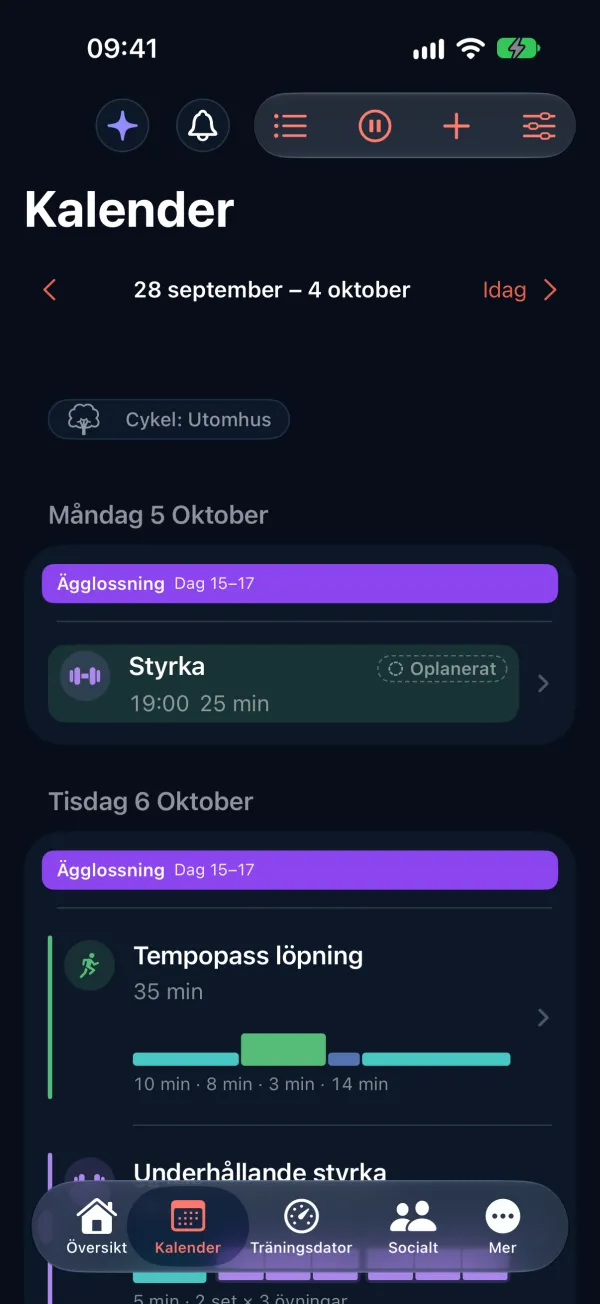
TriQuest builds the plan backwards from the race. For a full distance the last week is race week, the two weeks before it the taper, the four before those a race-specific phase and the eight before those the build. The rest is base, and if you have no training history the plan starts with one or two weeks of preparation. That makes 15 weeks counted from the build, and more with base before it. With less time, the base shrinks first and the taper last.
Within base, build and the race-specific phase every fourth week is lighter, about three quarters of the week before. For a full distance about 15 % of the time goes to swimming, 55 % to cycling and 30 % to running, and the long sessions grow toward at most about 5.5 hours on the bike and 2.5 hours of running (just under 4.5 and 2 hours for a first full distance). They are ceilings, not requirements.
How many hours you train is up to you: you set which days and how long you can, and the plan stays within it. The weeks below are examples from the build phase, not a plan. Your plan is built from your days, your time and where you are.
Example week: your first full distance, 8–10 hours
- Monday: rest.
- Tuesday: swim 45 minutes, technique and steady endurance.
- Wednesday: bike 75 minutes with threshold intervals.
- Thursday: run 50 minutes with threshold blocks, and strength 30 minutes.
- Friday: swim 45 minutes.
- Saturday: long ride, 3.5 hours. Every other week with a short run straight after.
- Sunday: long run, 1 hour 20 minutes, easy.
Example week: experienced triathlete, 12–15 hours
- Monday: swim 60 minutes.
- Tuesday: bike 90 minutes with threshold intervals, and an easy 40-minute run.
- Wednesday: run 60 minutes with threshold blocks.
- Thursday: swim 60 minutes, and strength 30 minutes.
- Friday: easy ride 60 minutes, or rest.
- Saturday: long ride, 4.5 hours. Every other week with a 20-minute run straight after.
- Sunday: long run, 1 hour 45 minutes, easy.
The plan is a proposal, never a rule. If you move a session, swap the sport for a day or ask the Coach for something else, it goes the way you choose.
Brick sessions and open water
Brick sessions, a run straight off the bike, are what make your legs feel at home when you leave transition in Kalmar. TriQuest puts them where they do the most good:
- None in the base.
- In the build every other loading week: an easy ride followed by a short, easy run.
- In the race-specific phase the week's long ride becomes the race session: the last two hours at race pace, then a run at race effort for a while before it turns easy.
- The first taper week: a short race session. Lighter weeks have none.
Open water
Swim workouts have a pace per 100 metres from your CSS and can be swum in the pool or open water. Once the water is warm enough for you, move some of them outside, and the Coach can propose open water sessions that you approve.
- Never swim alone in open water, and use a visible swim cap or buoy.
- Practise sighting, swimming close to others and getting out and running to transition.
- Try your wetsuit in water around 18–21 °C, as expected for 2026.
Fuel during the race
A full distance lasts many hours, and the cut-off is 16. Without fuel you stop long before the finish, and with too much at once your stomach says no. The guidelines TriQuest follows for races this long:
- 50–80 grams of carbohydrate an hour, by how used to it you are. An untrained stomach rarely takes more than 60.
- About 550 ml of fluid an hour as a starting point, more in heat and less in cold. Don't drink more than you sweat out.
- Sodium, about 500 mg per litre of fluid, unless you have measured your sweat.
- Work out your plan part by part with race nutrition, practise it on your long rides and follow it in the app on race day.
On the bike there are aid stations about every 20 kilometres and on the run at most 2.5 km apart. You can also leave a bag of your own fuel for the bike (at 122 km) and for the run (at 3, 17 and 30 km). Read more in the guide to race fuelling. This is training advice, not medical advice.
Race week
For a full distance the plan tapers over two weeks, to about 70 % and then 55 % of the volume, and race week to about 40 % with a short opener on the bike. The intensity stays, but the sessions get shorter, so you arrive at the start rested and sharp.
The packing list
- Swim: wetsuit, goggles (two pairs), the race's swim cap.
- Bike: a bike serviced in good time, helmet, shoes, bottles, spare tube and tools, fuel for the bike.
- Run: shoes you have run long in, a cap, a race belt, fuel for the run.
- Race number, timing chip and clothes to change into after the finish.
The transitions
In Kalmar your gear is in bags, one for the bike and one for the run, which you leave at check-in. Walk the route through transition beforehand, so you know where your bike and your bags are. Practise changing quickly but calmly: a few seconds either way don't decide a full distance.
The day before
Short and easy: an easy ride or run with a few short strides, food you know, pack your bags and go to bed early. In 2026 the bike park was open 05:00–06:30 on race morning, so plan your breakfast and travel around it.
Choose IRONMAN Kalmar in TriQuest
Search for IRONMAN Kalmar when you choose your race, and the name, date and distance are filled in. Tell TriQuest what your week looks like, which days suit long sessions and how much time you have, and the plan is built to the start: base, build, a race-specific phase and a taper. Workouts go to your Garmin, and the Coach follows up and proposes changes that you approve. When your week changes, the plan changes with it.
- Create account and choose IRONMAN Kalmar as your race.
- Read more about the full distance training plan and triathlon in TriQuest.
- Find more races in the race calendar.
Official page: ironman.com/races/im-kalmar. TriQuest is not affiliated with IRONMAN or the organiser; IRONMAN is a registered trademark of its owner.
Common questions
Common questions about IRONMAN Kalmar
When is IRONMAN Kalmar 2027?
IRONMAN Kalmar is on 21 August 2027.
How long is IRONMAN Kalmar?
A full distance: a 3.8 km swim, a 180 km ride and a 42.2 km run, 226 km in all.
What are the cut-off times at IRONMAN Kalmar?
Cut-offs 2026: 2 hours 20 minutes for the swim, 10 hours to the end of the bike and 16 hours for the whole race, counted from your own start. There are also road-closure times that apply to everyone.
How warm is the water in Kalmarsund?
About 20 °C on average; 18–21 °C was expected for 2026. The exact reading is announced on race morning.
Are wetsuits allowed at IRONMAN Kalmar?
Yes. Wetsuits are allowed up to and including 24.5 °C and mandatory below 16 °C. The decision is announced on race morning.
What is the bike course like?
One 180 km loop over the Öland Bridge, around southern Öland and back through the countryside north of Kalmar. It is flat and fast, with about 750 metres of climbing. The wind on Öland is what you notice most.
How many laps is the marathon?
A little over three laps. You pass the town centre four times and run north along the shore, finishing at Stortorget.
How many weeks do I need to train for IRONMAN Kalmar?
A TriQuest plan has 15 weeks from the build to the start: eight weeks of build, four race-specific, a two-week taper and race week. With more time you get base before it. With less time the phases shrink, the base first.
How many hours a week do I need for a full distance?
That's up to you: you set your time, and the plan stays within it. The examples in this guide start from 8–10 hours a week for a first full distance and 12–15 for an experienced triathlete.
Is IRONMAN Kalmar a good first full distance?
The course is flat, and everything you need is within 750 metres, which makes the day easy to keep track of. What decides it is having time to train and making the cut-offs with a margin.
Can I train for IRONMAN Kalmar with TriQuest?
Yes. Search for IRONMAN Kalmar when you choose your race, and the name, date and distance are filled in, and the plan is built to the start around your week.
What does it cost?
During the beta, everything is included at no cost.
More about TriQuest
Triathlon
Plans from sprint to full distance, with brick sessions, a taper and race nutrition.
Race calendar
Every race in TriQuest's race calendar, with place, distances and date.
Full distance
3.8 km, 180 km and 42.2 km: long sessions and fuel all the way.

Race nutrition
Carbohydrate, fluid and sodium for the race, step by step.
Race fuelling
Carbohydrate, fluid and sodium per hour, by the race's length.
Ready to train smarter?
Let TriQuest bring the plan, the workouts, the analysis and the coaching together in one place.